Contact Us

info@pqconintelli.com

Construction Intelligence Assessments™

Construction Intelligence Assessments™ | PQ Construction Intelligence™
Construction Intelligence Assessments™

Before You Transform the Business, Understand the Business.

Construction companies invest significant resources in technology, people, systems, processes, and growth.

But one question should come before another major investment:

Do we clearly understand where the business stands today?

PQ Construction Intelligence Assessments™ provide construction leaders with a structured executive examination of selected areas affecting organizational performance, modernization, technology, risk, customer experience, and future readiness.

Request an Assessment Conversation

Construction leaders reviewing business intelligence
Why assess first?

Transformation Without Diagnosis Is Expensive Guesswork.

Organizations often begin with a solution: “We need a new CRM.” “We need AI.” “We need automation.” “We need another project platform.” “We need better reporting.” “We need to digitize.” “We need new software.”

Perhaps they do. But perhaps the underlying problem is something else entirely.

A solution chosen before the problem is understood can become another problem.
Construction team diagnosing business issues
Inefficient process
Fragmented information
Poor adoption
Unclear responsibility
Duplicated systems
Weak governance
What is a Construction Intelligence Assessment™?

A Structured Executive Examination of the Business.

A PQ Construction Intelligence Assessment™ examines selected dimensions of a construction organization through a business, operational, technological, and executive lens.

Business & Leadership

Leadership priorities, business processes, operational practices, and organizational readiness.

Technology & Information

Technology, information flow, digital capability, customer management, and systems alignment.

AI & Automation

Artificial intelligence, automation opportunities, readiness, and human oversight.

Governance & Risk

Governance, risk, accountability, and emerging control considerations.

Because what appears to be a technology problem may actually be a business problem.
The executive value

Greater Clarity Before Greater Commitment.

A strong assessment can give leadership a more disciplined basis for answering the questions that matter before committing significant resources.

Where are our most important gaps?

What is working well and should be protected?

Where is unnecessary friction occurring?

Where could technology create meaningful value?

Are we ready for artificial intelligence?

What should we prioritize first?

The result should be a clearer understanding of what the business actually needs.
AI Readiness
Digital Maturity
Operational Excellence
Technology Assessment
AI readiness assessment

Is the Organization Ready for AI—or Simply Interested in It?

Interest in artificial intelligence is not the same as organizational readiness.

PQ’s AI Readiness Assessment examines selected organizational conditions surrounding responsible AI adoption and helps leadership identify where preparation may be required before broader implementation.

Can we use AI effectively, responsibly, and for a business reason that matters?
Leadership understanding
Business priorities
Technology environment
Information practices
Workforce capability
Governance
Risk
Data
Security
Human oversight
Culture
Change readiness
Digital maturity assessment

Owning Technology Is Not the Same as Being Digitally Mature.

A construction company may own numerous sophisticated platforms while employees continue relying on manual workarounds, disconnected spreadsheets, duplicated information, email-dependent processes, repeated data entry, informal reporting, systems that do not communicate, and technology employees barely use.

Digital maturity is reflected in how effectively technology, information, processes, and people work together to support the business.
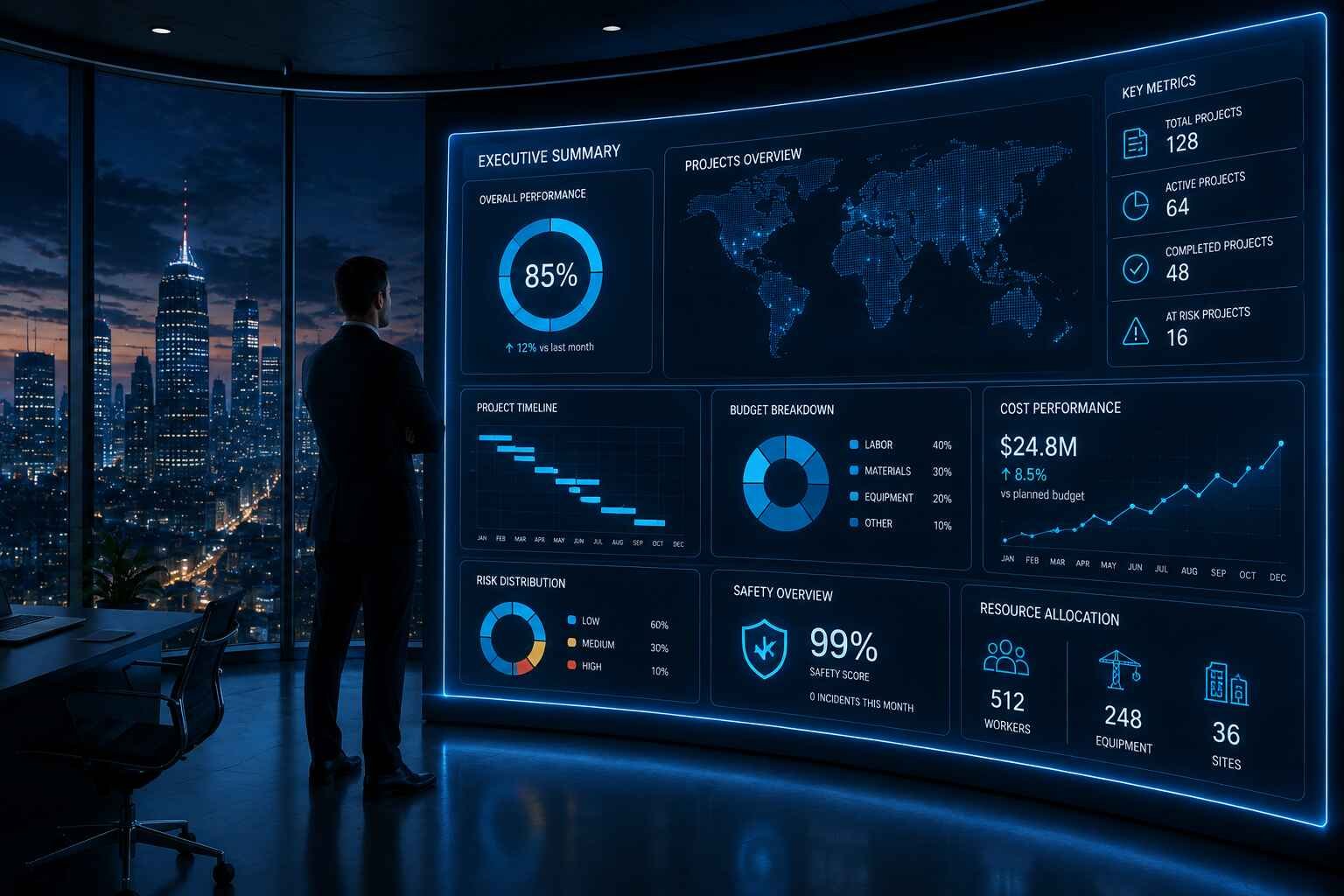
Digital maturity is not about having more technology. It is about extracting greater value from the right technology.
Construction technology and digital systems
Operational excellence assessment

Where Is the Business Working Harder Than It Should?

Over time, organizations accumulate complexity. Employees adapt and make the system work—but adaptation can hide inefficiency from leadership.

Hard work should create value—not compensate indefinitely for weak processes.
Extra approvals
Repeated admin tasks
Workarounds
Duplicated processes
Manual handoffs
Unclear responsibilities
Information bottlenecks
Legacy practices
Construction technology assessment

Is Your Technology Environment Supporting the Business—or Complicating It?

Construction technology environments can become increasingly complex as companies grow. Each system may have been introduced for a valid reason; together, however, they may create duplication, fragmentation, underutilization, unnecessary expense, or difficult information flows.

What is being used?

What is underused?

Where is duplication occurring?

Where do employees rely on workarounds?

Where does information fragment?

Could consolidation help?

Can current capability be used better?

Where is new technology genuinely required?

The goal is not a larger technology stack. The goal is a stronger business.
Business process assessment

Every Process Has a Cost.

Some costs are obvious. Others are hidden inside time. Repeated hundreds or thousands of times, friction becomes expensive.

Small friction repeated at scale becomes enterprise friction.
Simplification
Standardization
Improved information flow
Greater consistency
Appropriate automation
Clearer responsibility
Reduced duplication
Better technology alignment
Risk & governance assessment

What Has Changed Faster Than Your Controls?

Technology adoption can move faster than organizational governance. Employees begin using AI, new vendors enter the environment, information moves through additional systems, business processes become increasingly digital, customer and company information becomes more accessible, and automation expands.

PQ’s Risk & Governance Assessment examines selected areas involving responsible technology and AI use, organizational oversight, human accountability, information practices, and emerging governance considerations.

Stronger governance may allow innovation to proceed with greater confidence.
Risk governance and leadership discussion
Customer experience assessment

What Does It Feel Like to Do Business With Your Company?

Construction companies often evaluate project performance rigorously. The customer journey deserves similar attention.

Excellent construction deserves an equally disciplined customer experience.
Inquiry response
Relationship ownership
Customer information
Opportunity follow-up
Milestone communication
Post-completion experience
CRM environment
Commercial visibility
What we look for

Strengths Matter as Much as Gaps.

An assessment should not be an exercise in finding everything wrong with a company. Successful construction businesses already possess significant strengths.

PQ wants to understand those strengths as well, because transformation should not destroy what already works.

Identify the strengths. Understand the gaps. Protect what creates value. Improve what limits performance.

Experienced people

Trusted relationships

Proven practices

Institutional knowledge

Effective systems

Strong cultures

From symptoms to root causes

Fix the Cause, Not Just the Complaint.

Consider a company experiencing slow customer follow-up. The visible problem is response time, but the underlying issue could involve several interacting factors.

PQ assessments are designed to look beneath symptoms and develop greater clarity around what may actually be driving them.
Unclear ownership
Fragmented customer information
No CRM discipline
Manual notifications
Poor process design
Insufficient staffing
Technology limitations
The output

Leadership Should Leave With Greater Clarity Than It Started With.

The specific deliverables depend on the assessment scope and engagement. However, PQ assessment work is designed to provide leadership with useful executive intelligence.

Current-State Understanding

A clearer picture of selected organizational conditions.

Strengths

Capabilities and practices worth protecting or building upon.

Gaps

Areas where current conditions may not adequately support business objectives.

Opportunities

Areas where improvement, modernization, technology, automation, or organizational change may create value.

Risk Considerations

Selected issues that may warrant additional leadership attention or specialist review.

Priorities & Strategic Direction

Greater clarity around what deserves attention first and potential next steps.

The assessment should support decisions—not sit on a shelf.
What happens after the assessment?

Assessment Is the Beginning of Clarity—not an Obligation to Buy More Services.

Following an assessment, leadership may choose the response that best fits the evidence and business need.

Improve Internally

Address an issue internally, improve a process, or provide employee education.

Adjust Technology

Change a configuration, evaluate a new platform, or strengthen CRM practices.

Launch Focused Change

Begin automation, AI governance, or a strategic roadmap.

Choose Not to Act Yet

Engage another specialist, continue with PQ, or deliberately do nothing yet.

Every assessment does not need to become a transformation project.
Prioritization

Finding 30 Opportunities Is Easy. Knowing Which Three Matter Is Harder.

Transformation initiatives often fail because organizations attempt too much simultaneously. Leadership resources, capital, employee attention, and organizational capacity for change are finite.

Prioritization turns information into executive intelligence.
1What matters most?
2What creates the greatest potential value?
3What has important dependencies?
4What carries meaningful risk?
5What is realistically achievable?
6What can wait—or should not be pursued?
Who should consider an assessment?

Particularly Valuable Before Major Change.

Rapid growth

The company is growing rapidly or preparing for digital transformation.

Major investment

Leadership is considering significant technology investment or AI adoption.

Fragmentation

Technology, information, or operational complexity is increasing.

Customer & visibility issues

Customer processes require improvement or leadership lacks visibility.

Administrative burden

Administrative work is consuming excessive time.

Need for direction

The company wants to modernize but does not know where to begin.

The questions an assessment should answer

At the End, Leadership Should Know More Than It Did at the Beginning.

Where are we today?

What is working?

What is not working as well as it should?

Where are we vulnerable?

Where is opportunity?

What deserves attention?

What should come first?

What requires additional expertise?

What should we invest in?

What should we avoid?

And ultimately: What should we do next?
What PQ does not do

No Predetermined Diagnosis.

PQ does not begin an assessment assuming you need AI, automation, new software, replacement systems, broken-process remediation, or transformation.

The evidence should lead the recommendation. Not the other way around.

Independence matters

That independence is fundamental to the value of the assessment.

Protecting PQ’s methodology

A Disciplined Process. A Clear Executive Experience.

PQ Construction Intelligence Assessments™ are supported by structured internal methodologies developed to examine relevant business conditions consistently and thoughtfully.

Clients receive the intelligence, findings, strategic perspective, and agreed deliverables associated with their engagement.

Our clients receive the value of the methodology—not a blueprint for reproducing it.
Executive methodology and structured assessment
The PQ principle

Diagnose Before You Prescribe.

Construction professionals understand this instinctively. You would not repair a structural problem based solely on appearance. You investigate, understand the conditions, determine what is actually happening, and then decide what intervention is appropriate.

01

Assess.

02

Understand.

03

Prioritize.

04

Then act.

Final CTA

Before the Next Major Investment, Ask One More Question.

Not: “What should we buy?”

“What does our business actually need?”

That question can prevent wasted investment, reveal hidden opportunity, clarify priorities, expose risk, protect what already works, and change the direction of an entire transformation initiative.

PQ Construction Intelligence™ brings structured executive intelligence to that question.

Clarity Before Transformation.

Request an Assessment Conversation
PQ Construction Intelligence executive assessment
PQ Construction Intelligence™
Executive Intelligence for the Built World.™