Executive Intelligence
Support leaders in organizing information, examining business questions, identifying patterns, summarizing complex material, and preparing for decisions.
info@pqconintelli.com
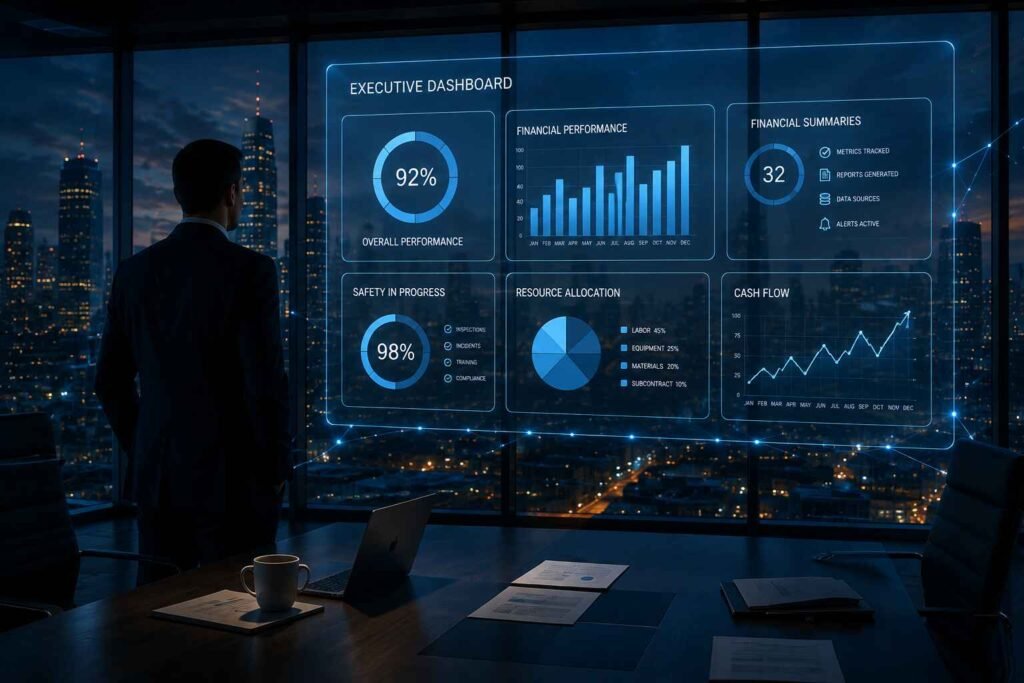
Artificial intelligence is changing what construction companies can see, automate, analyze, communicate, and accomplish.
But technology alone does not create transformation.
PQ Construction Intelligence™ partners with construction leaders to identify where AI and digital capabilities can create meaningful business value—and where technology should not be the answer.
Our approach is business-first, human-centered, risk-aware, and built around one objective:
The same technologies capable of increasing productivity can also create exposure when adopted carelessly.
Construction organizations may need to consider:
The question therefore cannot simply be:
Leadership must also ask:
PQ helps executives consider both sides of that equation.

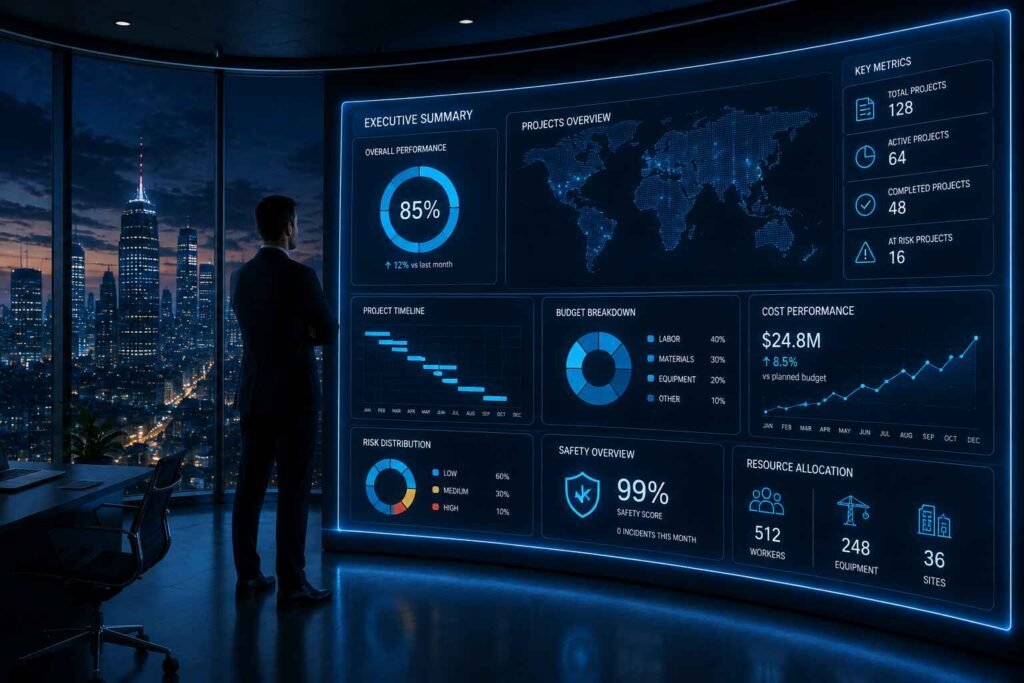
PQ does not begin an AI conversation by asking:
We begin with different questions.
Only then should technology enter the conversation.
Not the other way around.
Artificial intelligence has potential far beyond generating emails or summarizing documents.
When appropriately applied, AI can support a wide range of business functions.
Support leaders in organizing information, examining business questions, identifying patterns, summarizing complex material, and preparing for decisions.
Assist with information management, recurring administrative processes, workflow coordination, reporting, and organizational visibility.
Help organizations make institutional knowledge easier to organize, locate, understand, and use.
Support communication, inquiry management, follow-up, information access, and more consistent customer interactions.
Assist with research, opportunity organization, preparation, communication, and commercial intelligence.
Support appropriate classification, summarization, extraction, organization, routing, and retrieval of business information.
Provide additional analytical support for planning, communication, scenario exploration, and executive preparation.
Help make internal knowledge, policies, procedures, and educational material more accessible to teams.
An organization can purchase sophisticated technology and still be unprepared to use it effectively.
AI readiness extends beyond IT infrastructure.
PQ helps construction leaders examine the organizational conditions surrounding responsible AI adoption before major investments or transformation initiatives move forward.
Readiness determines whether AI becomes a business capability—or another underused subscription.
Replacing paper with software is digitization. Adding more applications is not necessarily modernization. And connecting employees to more dashboards does not automatically produce better decisions. Meaningful digital transformation improves how the organization operates.
It can strengthen:
Information flow
Executive visibility
Process consistency
Customer experience
Collaboration
Decision-making
Operational efficiency
Knowledge accessibility
Scalability
Business resilience
Business resilience
Business resilience
PQ approaches digital transformation as an enterprise challenge—not an IT shopping exercise.
Construction companies may accumulate technology over years of growth.
Eventually, leadership may discover that the organization owns considerable technology while information is still difficult to access and processes remain heavily manual.
Sometimes the problem is too much disconnected technology.
PQ helps organizations examine the relationship between systems, processes, information, people, and business requirements before assuming another platform is the solution.
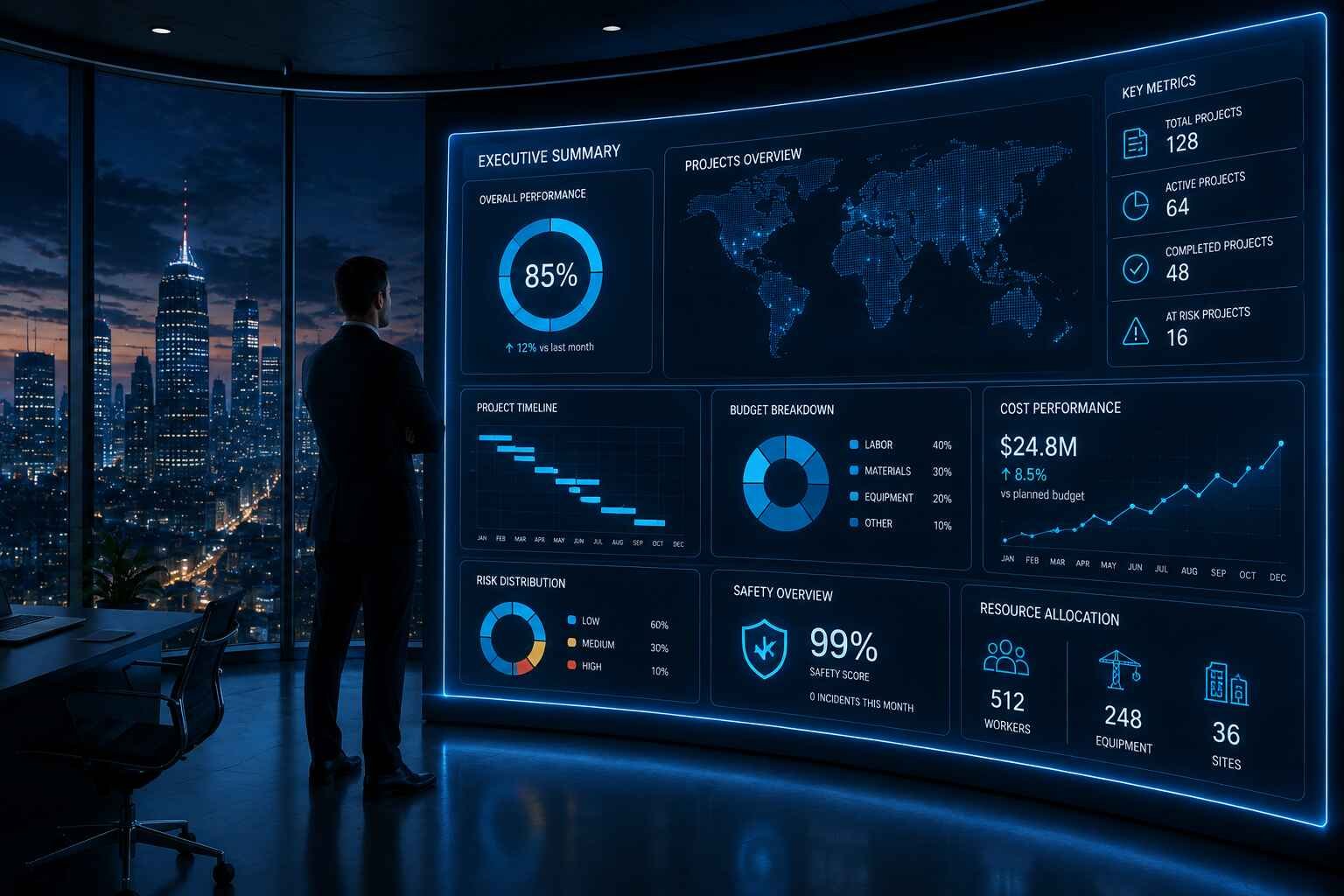
Automation can create tremendous value when applied to the right work. But PQ does not advocate automation simply because something can be automated. We examine whether automation can meaningfully:
Construction businesses operate in environments where experience, accountability, relationships, safety, interpretation, and professional judgment matter enormously. The strongest operating model is rarely human versus machine.
It is:
A technically perfect system that employees refuse to use is not a successful transformation. People need to understand:
As AI becomes easier to access, organizations need greater clarity around its use.
Without clear expectations, employees may independently place company information into public AI systems, rely on inaccurate outputs, introduce unapproved applications, or unknowingly expose sensitive information.
Governance does not exist to stop innovation.
PQ helps construction leaders consider areas such as:
PQ’s AI and digital transformation services may include:
Examine organizational preparedness, opportunities, potential barriers, and selected risk considerations surrounding AI adoption.
Identify areas of the business where AI may warrant further consideration based on business value and organizational priorities.
Support leadership in defining how artificial intelligence should—and should not—fit within the organization’s broader business strategy.
Examine how effectively current digital systems, practices, processes, and information environments support the organization.
Develop strategic direction for improving how technology supports operations, customers, employees, leadership, and growth.
Identify repeatable workflows where appropriate automation may reduce administrative burden or strengthen consistency.
Examine whether existing and proposed technologies align with business requirements and strategic priorities.
Support leadership in establishing clearer expectations, oversight, and responsible-use considerations around AI.
Equip leaders with practical understanding of AI capabilities, limitations, opportunities, risks, and strategic implications.
Translate priorities into an organized sequence of initiatives so the organization can modernize deliberately rather than attempting everything at once.


One of the most expensive assumptions in digital transformation is:
And sometimes the smartest decision is to leave something exactly as it is.
PQ evaluates technology from the perspective of the business—not from the perspective of selling a particular product.
Not every transformation needs to begin across the entire enterprise.
For emerging technologies—particularly artificial intelligence—a focused implementation can allow organizations to learn before making larger commitments.
A disciplined approach may allow leadership to:
Then determine whether broader deployment is justified.

Technology initiatives should ultimately connect to business outcomes.
Depending on the initiative, leadership may consider improvements in areas such as:
Time
Has unnecessary administrative effort been reduced?
Visibility
Can leaders access important information more effectively?
Consistency
Are processes being performed more reliably?
Capacity
Can teams accomplish more without proportionally increasing administrative burden?
Customer Experience
Has responsiveness, communication, or service consistency improved?
Risk
Has the organization strengthened control, oversight, or accountability?
Decision Quality
Does leadership have better information with which to make important decisions?
Adoption
Are people actually using the capability effectively?
PQ Construction Intelligence™ is not built around selling a particular AI model, software platform, or technology ecosystem.
That independence matters.
Our responsibility is to ask:
Not:
We believe technology earns its place when it strengthens the organization.
1. Where are employees already using artificial intelligence—whether leadership knows it or not?
2. What company, employee, project, or client information could be entering external AI systems?
3. Which business processes could genuinely benefit from AI or automation?
4. Who is accountable for verifying AI-supported work and decisions?
5. What business outcome would justify our investment in AI?
If leadership cannot confidently answer these questions, the organization may not need more AI yet.


Artificial intelligence will continue improving.
Software will continue evolving.
Automation will continue expanding.
The competitive question will not simply be who adopts technology first.
It will be:
PQ Construction Intelligence™ helps construction leaders approach that future deliberately.