
Construction businesses run on people—their judgment, relationships, experience, decisions, and ability to solve problems when conditions change.
Yet valuable employees can spend significant portions of their day on repetitive administrative work that adds little value simply because “that’s how we’ve always done it.”
PQ Construction Intelligence™ helps construction organizations identify where intelligent automation can reduce unnecessary friction, strengthen consistency, improve information movement, and create greater organizational capacity.
Every construction organization contains small repetitive activities. Individually, they may appear insignificant. Repeated daily across multiple employees, projects, departments, and years, they can consume substantial organizational capacity.

It is about designing work more intelligently. Construction automation can connect processes, systems, information, rules, and increasingly artificial intelligence so selected repetitive activities can occur with less manual intervention.
Move information, route tasks, coordinate handoffs, and organize documents.
Create notifications, trigger follow-up, and initiate the next appropriate workflow step.
Update records, support reporting, and generate routine summaries.
Assist information retrieval while keeping people responsible for human judgment.
One of the fastest ways to create sophisticated inefficiency is to automate a process nobody should be doing in the first place.
Why does this process exist?What outcome is it supposed to create?
Which steps add value?Which steps are unnecessary?
Where does information enter and go?Who needs to make a decision?
Where is human review essential?Only then should automation enter the conversation.
Some of the greatest automation opportunities are not dramatic. They live between larger activities.
A customer submits an inquiry. Someone needs to route it.
A document arrives. Someone needs to organize it.
A status changes. Someone needs to notify another person.
A task is completed. Another activity should begin.
A date approaches. Someone needs a reminder.
Someone spends an hour preparing the same information every week.
Route inquiries, initiate appropriate responses, create tasks, notify responsible team members, and support more consistent follow-up.
Support lead routing, opportunity updates, reminders, pipeline activities, and selected relationship-management workflows.
Assist with appropriate document intake, organization, classification, routing, notifications, and information extraction.
Automatically alert the appropriate people when defined events, conditions, or workflow stages occur.
Route selected requests through defined approval processes while preserving human decision authority.
Reduce repetitive preparation involved in gathering, organizing, or summarizing selected routine information.
Trigger appropriate next steps when defined activities are completed.
Support employees in locating appropriate organizational information more efficiently.
Assist selected routine communications while maintaining appropriate review, escalation, and human involvement.
Reduce repetitive work across selected internal business processes.
Traditional automation generally follows predefined rules: If this happens → do that.
Artificial intelligence can expand what selected workflows are capable of doing.
These possibilities also introduce considerations around accuracy, information handling, security, governance, and human oversight.
Low-risk, clearly defined activities that may appropriately occur without routine human intervention.
Technology performs part of the work, but a person verifies or approves the result.
Technology may provide information or assistance, but decision authority remains with an accountable person.
Customer automation is often misunderstood. The goal is not to replace every human interaction with a chatbot.
The goal is to make sure technology handles appropriate routine activities so people can devote greater attention to interactions where relationships matter.

Construction business development often spans months or years. Relationships matter. Timing matters. Follow-up matters.
Opportunities can become fragmented across email, spreadsheets, personal notes, calendars, and individual memory.
Construction businesses generate and receive substantial volumes of documents, forms, emails, requests, reports, customer information, vendor information, internal records, and approvals.
Selected automation may assist with moving appropriate information through defined workflows more efficiently.
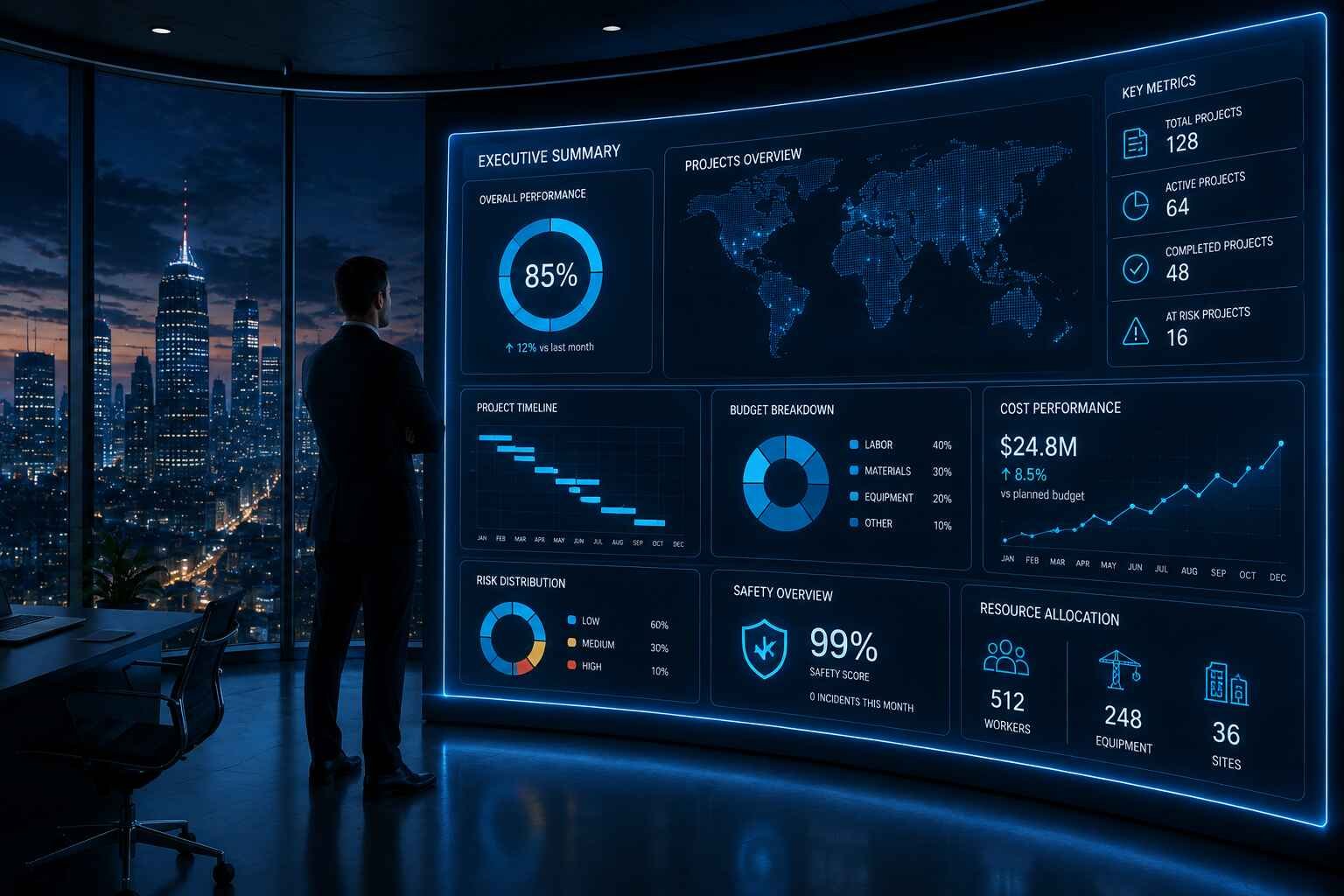
The objective is not uncontrolled document processing. It is disciplined information movement with appropriate access, review, security, and accountability.
Recurring reporting can require employees to gather information from multiple sources, clean it, organize it, summarize it, and distribute it. Where appropriate, automation may reduce parts of that preparation.
Organizations accumulate tremendous institutional knowledge, but knowledge has limited operational value when employees cannot locate it.
Modern AI and automation can create new ways for organizations to organize and access approved internal knowledge.
Is the process clearly understood and reasonably consistent?
Are responsibilities defined? Who owns the workflow?
Is the information reliable? Are exceptions understood?
Are the systems accessible and suitable for automation?
Does the automation create enough value? What happens if it fails?
Where is human review required? What security or privacy considerations exist?
Does it reduce meaningful effort, friction, delay, inconsistency, or risk?
Does the activity happen often enough to justify automation?
Is the underlying process consistent enough to automate?
Will the automation simplify the work—or create another system employees must manage?
What happens if the automation performs incorrectly?
Where is human review required?
Who will own the automation after implementation?
Will employees actually use the resulting workflow?
Identify selected repetitive workflows where automation may warrant further evaluation.
Examine how information, tasks, decisions, systems, and people interact within selected processes.
Simplify and strengthen selected workflows before automation is introduced.
Determine where automation aligns with organizational priorities and business value.
Evaluate selected opportunities where AI capabilities may appropriately strengthen automated processes.
Define where human review, approval, verification, escalation, or decision authority should remain.
Support the controlled introduction of selected automation capabilities appropriate to the engagement.
Support practical integration of new workflows into the organization’s operating environment.
Establish appropriate ownership, oversight, review, and accountability around selected automated processes.
Evaluate whether implemented automation is creating the intended operational value.
PQ does not believe automation should remove meaningful human judgment from high-consequence areas.
Specialized professional requirements may also require appropriate legal, cybersecurity, engineering, financial, privacy, or regulatory expertise.
Organizations do not need to automate the entire company at once. A focused workflow can create an opportunity to validate the business case, test adoption, identify exceptions, evaluate risk, measure time savings, improve governance, and learn what works.
Prove the business caseStart with a focused workflow.
Learn from useTest adoption and understand exceptions.
Improve the workflowMeasure time savings, risk, and governance.
Scale only when justifiedExpand based on evidence, not enthusiasm.
A successful automation should produce meaningful operational improvement.
Has manual effort decreased?
Does work move faster?
Is the process being executed more reliably?
Has unnecessary manual re-entry or processing decreased?
Can employees devote more attention to higher-value work?
Has responsiveness or consistency improved?
Can leadership understand the workflow more clearly?
Are employees actually using the new process?
If technology saves an employee five hours every week, what happens to those five hours?
Those answers may reveal where automation deserves attention.
Technology is exceptionally good at repetition. People are exceptionally valuable at judgment, relationships, leadership, creativity, problem-solving, negotiation, empathy, adaptation, accountability, and complex decision-making.
PQ believes organizations should use technology to reduce unnecessary mechanical work so people can devote more attention to the capabilities that make them valuable in the first place.